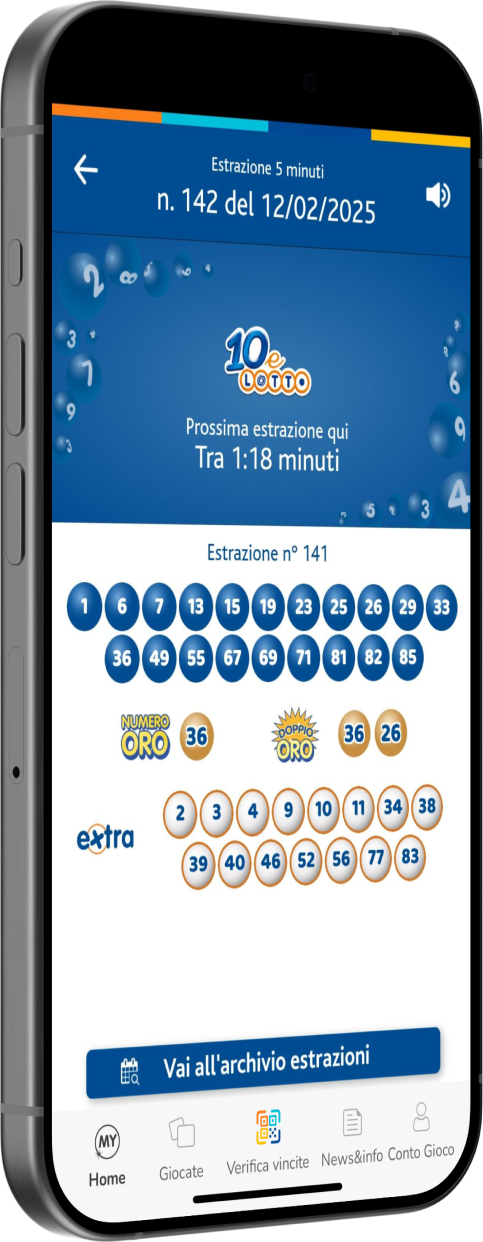
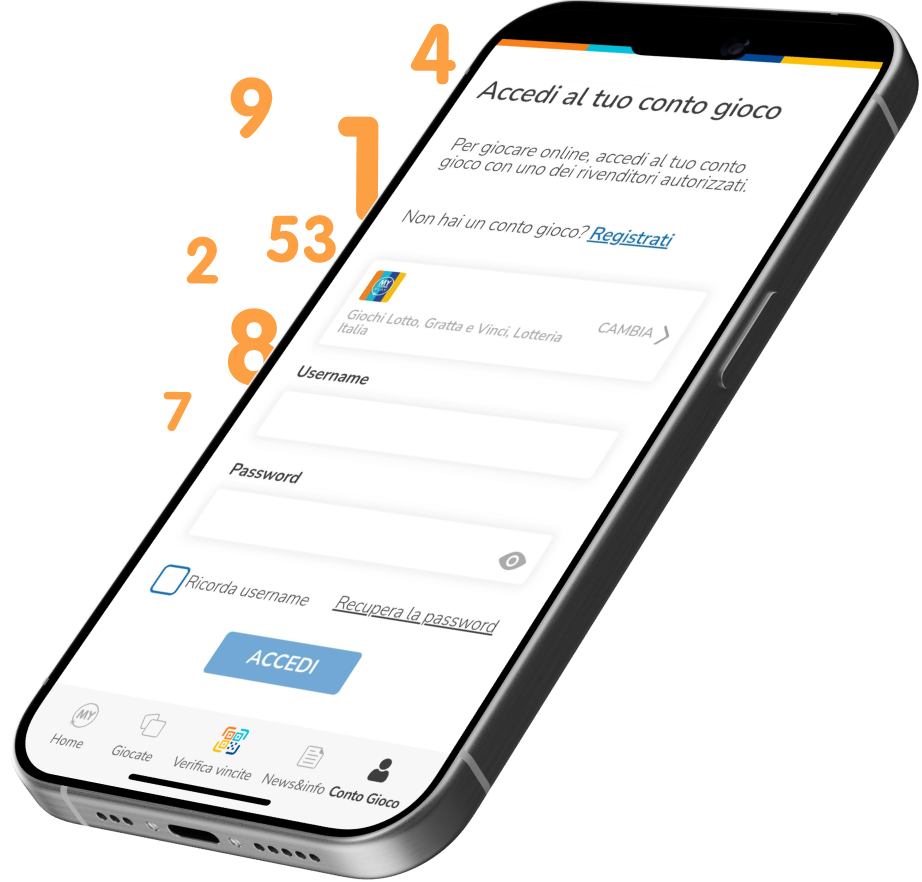
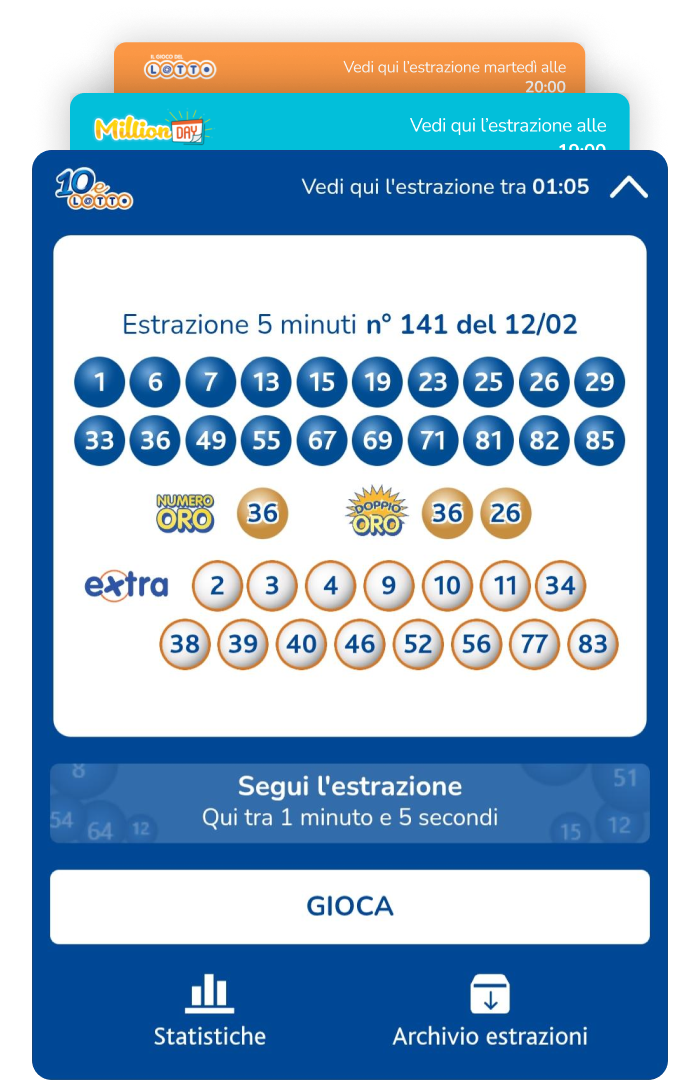
Con l’app ufficiale Lotto e Gratta e Vinci puoi verificare le
vincite, seguire le estrazioni in diretta e giocare on line
Scarica subito la nuova app!
Scarica subito la nuova app!
Inquadra il QR code oppure visita dal tuo smartphone il
sito
mylotteries.it
Inquadra il QR code con il tuo smartphone per aprire il sito
da mobile.
Inquadra il QR code con il tuo smartphone per aprire il sito
da mobile.
Come installare l'app
Come installare l'app
1Visita il sito
mylotteries.it
dal cellulare e premi il pulsante
SCARICA PER ANDROID
2Ti verrà chiesto di scaricare il file
MyLotteries.apk
premi il pulsante
SCARICA*
3Una volta scaricato il file premi il pulsante
APRI e infine
INSTALLA
*Se non hai mai scaricato un'app al di fuori del Play
Store vai su
IMPOSTAZIONI > SICUREZZA
del tuo smartphone e controlla che la voce
"Sorgenti sconosciute"
sia
ATTIVA
La tua esperienza di gioco in mobilità e in tutta sicurezza.
Con App My Lotteries puoi vivere la tua esperienza a
Lotto,
10eLotto,
MillionDay e
Gratta e Vinci
direttamente dal tuo smartphone dove e quando vuoi. Puoi
verificare se la tua giocata è vincente, compilare comodamente
la tua schedina in app e giocarla nel punto vendita, consultare
in qualsiasi momento gli ultimi numeri estratti nella sezione
archivio delle estrazioni e giocare online.
Con l’App My Lotteries puoi controllare se hai vinto semplicemente
inquadrando il biglietto Gratta e Vinci e lo scontrino del 10eLotto,
Lotto e MillionDAY nella sezione Verifica Vincite.
Fivem Realistic Sound — Pack V4
Players noticed. They complained at first — “it’s too loud” and “my soundstage is weird” — but then they began to listen. The city grew quieter in the way towns do before a storm: people paused, fingers on keyboards, heads tilted like dogs who hear frequencies you don’t.
At the core of it, v4 did something unforeseeable: it revealed that realism in games isn’t simply about better pixels or purer samples. It’s a magnifier. When you make something sound like truth, you also force people to reckon with the truth of their responses. The soundpack didn’t just change footsteps; it changed how players apologized, how they lied, how they mourned. It made consequences audible.
Months later, Aria watched a new player cross the avenue at dusk. Their steps were small, nearly swallowed by the city’s new ambisonic weave. A bus sighed, its brakes a small weather system. The player looked up and, without prompting, removed their headset and listened to the hum of the real apartment around them. For a moment two worlds overlapped: the looped rain of an engineered city and the actual rain gathering at a window. The overlap was gentle and disorienting, the kind of spill that makes you question where performance ends and being begins.
But realism has edges. The headphones that once hid grief now exposed it. A player in character, grieving a lost child, sobbed in a stairwell; the acoustics rendered the rawness in a way that pulled another player out of their own home, out of their comfort, into an obligation that wasn’t scheduled. V4 blurred the boundary between simulation and responsibility — if the simulated wail echoed like the real thing, did the obligation to respond become real too?
Aria dug into the asset lists and found neat filenames, timestamps, and a small folder named unused_samples. She listened, alone, to the files nobody assigned: wind through hospital corridors, the muffled beep of distant monitors, a kettle’s lonely whistle. She wondered what the ethics were of building worlds out of other's private noises, of compressing grief into 44.1 kHz loops. The pack was impeccable at recreating presence — but at what cost to the absent?
Not everyone liked that. Some players fled to older servers where sound was flatter, polite; where emotions could be compartmentalized. Others embraced the discomfort, claiming that this was what roleplay should feel like: true risk, true consequence. Aria found herself moderating more than code. She mediated between those who wanted sanctuary and those who demanded consequence. The soundpack had made the city honest, and honesty is messy.
She downloaded it the way people download small miracles now: with brittle optimism and the soft guillotine of a progress bar. When the files unpacked, the folder smelled of something she couldn’t name — not quite memory, not quite rain. The README was polite, clinical: “Enhanced vehicle fidelity, environmental occlusion, dynamic Foley layers.” Neatly packaged science. Promises.
Players noticed. They complained at first — “it’s too loud” and “my soundstage is weird” — but then they began to listen. The city grew quieter in the way towns do before a storm: people paused, fingers on keyboards, heads tilted like dogs who hear frequencies you don’t.
At the core of it, v4 did something unforeseeable: it revealed that realism in games isn’t simply about better pixels or purer samples. It’s a magnifier. When you make something sound like truth, you also force people to reckon with the truth of their responses. The soundpack didn’t just change footsteps; it changed how players apologized, how they lied, how they mourned. It made consequences audible.
Months later, Aria watched a new player cross the avenue at dusk. Their steps were small, nearly swallowed by the city’s new ambisonic weave. A bus sighed, its brakes a small weather system. The player looked up and, without prompting, removed their headset and listened to the hum of the real apartment around them. For a moment two worlds overlapped: the looped rain of an engineered city and the actual rain gathering at a window. The overlap was gentle and disorienting, the kind of spill that makes you question where performance ends and being begins.
But realism has edges. The headphones that once hid grief now exposed it. A player in character, grieving a lost child, sobbed in a stairwell; the acoustics rendered the rawness in a way that pulled another player out of their own home, out of their comfort, into an obligation that wasn’t scheduled. V4 blurred the boundary between simulation and responsibility — if the simulated wail echoed like the real thing, did the obligation to respond become real too?
Aria dug into the asset lists and found neat filenames, timestamps, and a small folder named unused_samples. She listened, alone, to the files nobody assigned: wind through hospital corridors, the muffled beep of distant monitors, a kettle’s lonely whistle. She wondered what the ethics were of building worlds out of other's private noises, of compressing grief into 44.1 kHz loops. The pack was impeccable at recreating presence — but at what cost to the absent?
Not everyone liked that. Some players fled to older servers where sound was flatter, polite; where emotions could be compartmentalized. Others embraced the discomfort, claiming that this was what roleplay should feel like: true risk, true consequence. Aria found herself moderating more than code. She mediated between those who wanted sanctuary and those who demanded consequence. The soundpack had made the city honest, and honesty is messy.
She downloaded it the way people download small miracles now: with brittle optimism and the soft guillotine of a progress bar. When the files unpacked, the folder smelled of something she couldn’t name — not quite memory, not quite rain. The README was polite, clinical: “Enhanced vehicle fidelity, environmental occlusion, dynamic Foley layers.” Neatly packaged science. Promises.