Dhaka-Facts
    - Good to know
    edomcha thu naba gi wari 53 upd free

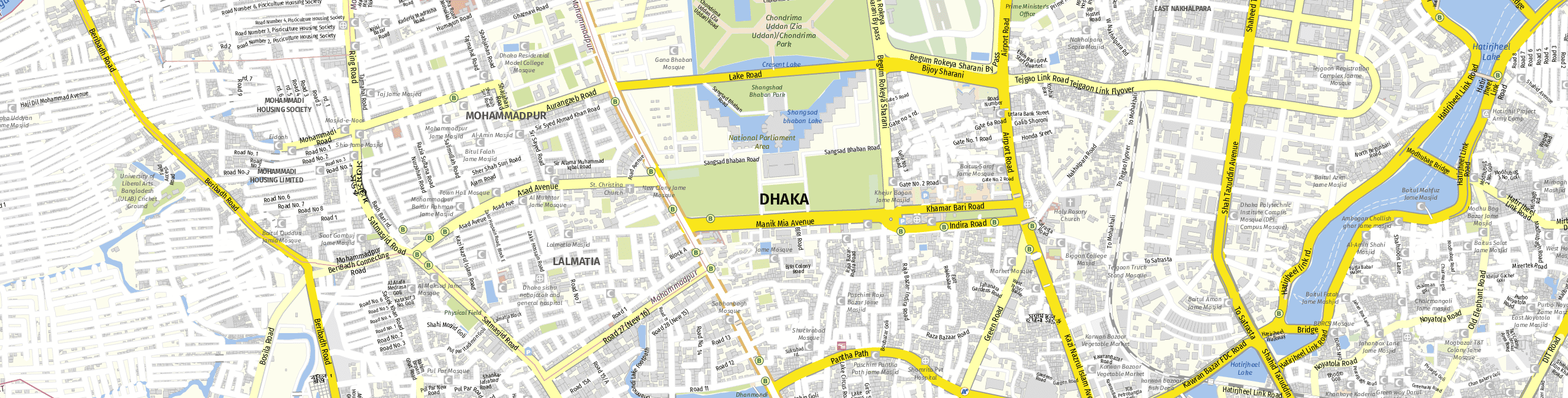
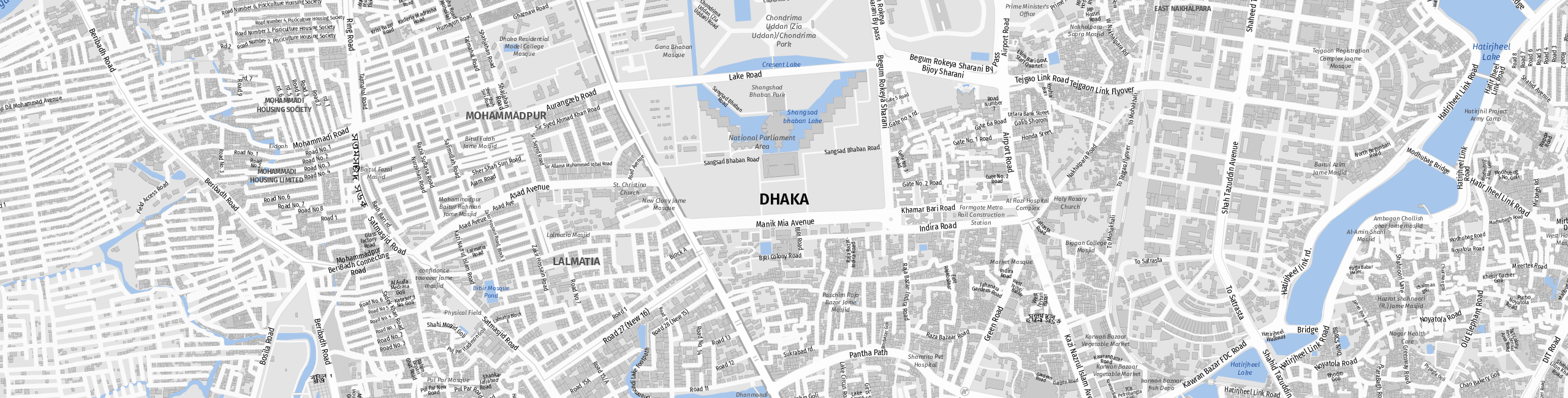
    Our city map of Dhaka (Bangladesh) shows 29,650 km of streets and paths. If you wanted to walk them all, assuming you walked four kilometers an hour, eight hours a day, it would take you 927 days. And, when you need to get home there are 801 bus and tram stops, and subway and railway stations in Dhaka.

    With a total area of 6 square kilometers, public green spaces and parks make up 0.029% of Dhaka’s total area, 20,413 square kilometers. That means each of Dhaka’s 21,741,000 residents has an average of 0.3 square meters.

    When people in Dhaka want to go out, they are spoilt for choice; our map shows more than 115 cafés, restaurants, bars, ice-cream parlors, beer gardens, cinemas, nightclubs and theatres. The city also boasts more than 252 sights and monuments, and far more than 9,979 retailers. Feeling tired? Our map shows more than 395 hotels and guest houses, where you can rest.


    • Map download service

      City, regional and country maps from Kober-Kuemmerly+Frey can be generated with the optimum print or screen resolution for every application. Use our maps in your image brochures and travel catalogues, or on your website. Or add an attractive location map to your real estate flyer. edomcha thu naba gi wari 53 upd free

    The following companies use maps from mapz.com

    • Marlit-Christine Heinersdorff
      LOOXX* magazine
      Thanks to mapz.com, the service city map in our LOOXX* magazine uses our corporate colors. Brilliant!
    • Dieter C. Rangol
      German Swimming Pool Federation
      mapz.com gives our member companies rapid, easy access to professionally designed location maps for their websites, brochures and catalogues.
    • Daniel Tolksdorf
      Aengevelt Real Estate
      mapz.com offers the best looking maps for our high-quality real estate flyers.
    • Silja Schelp
      Humboldt Travel
      mapz.com helps us create attractive maps showing the special features of our tours, anywhere in the world.

    Edomcha Thu Naba Gi Wari 53 Upd Free Online

    The phrase asks us to be translators. It summons rituals of interpretation: we stitch context from sound, imagine backstories for syllables, and allow the unknown to be generous. Each reader will supply different weights—some will hear a border dispute, others a technological prompt, others a refugee’s plea. That plurality is the phrase’s power. It refuses to mean only one thing because its pieces are chosen to be porous.

    Finally: "free." The simplest word complicates everything. Free is a destination and a danger: liberation and license, emptiness and overflow. In this phrase, free is not declarative but interrogative—an invitation to measure what freedom costs and who is permitted to claim it. Is freedom the condition of being unbound, or the capacity to write new names into the ledger of a world that prefers old ones?

    "upd" arrives like a modern whisper—abbreviation, compression, the breathless shorthand of a world that must relay everything in fragments. Update. Uprising. Updraft. The letters suggest change in motion: revision without apology, a file saved over the old, a manifesto posted at dawn. "Upd" is the seam between what was and what will be, the small press of the fingertip that moves history along a second at a time.

    In the end, this string of syllables is less an answer than an opening. It is a gate carved into a wall of complacency: walk through and you might find a marketplace, a battlefield, a library, a home. Or you might find empty land, invitation enough. Either way, the phrase asks us to engage, to project, to make kin with ambiguity—and in that making, to discover what "free" might yet mean.

    "gi wari" tightens the focus. "Gi" is a connector, a hinge; "wari" could be battle, wound, bargain, or sunrise—ambiguous, insistently alive. Here the phrase becomes an economy of conflict and care: a bargain struck in the language of need; a wound tended in the grammar of return. It is where the personal and political entangle, where private lament becomes public ordinance.

    In the hush between breaths, a phrase lands like a coin flipped into a dark well: "edomcha thu naba gi wari 53 upd free." It reads like a cipher—part chant, part catalogue entry—an incantation for a world that both resists and demands translation. Each fragment is a breadcrumb; together they map a strange borderland where language, identity, and freedom collide.

    Read together, "edomcha thu naba gi wari 53 upd free" is a miniature epic. It is the headline of a movement and the whisper of a lover, the title on a crumpled leaflet and the last line of a suppressed letter. It maps a trajectory from origin (edomcha), through absence (thu naba), through conflict or stewardship (gi wari), counted and chronicled (53), shifted toward the present (upd), and finally hung like a banner: free.

    "edomcha" opens the scene with mystery. It feels like a name borrowed from dusk—an exile, a ship, a memory. The syllables carry salt and smoke; they suggest origin and erosion, an artifact of weathered tongues. If "edomcha" is a place, it is one that refuses tidy cartography: narrow alleys of grammar, markets of metaphor, a coastline where histories wash up in fragments.